For Immediate Release
July 17, 2026
Contact:
- Roger Dobson, Protect the WolvesTM, (714) 750-6878, roger@
protectthewolves.com - Erik Molvar, Western Watersheds Project, (307) 399-7910, emolvar@
westernwatersheds.org - Dr. Bridgett vonHoldt, Princeton University, 609-258-7021, vonholdt@princeton.edu
Tribal wolf advocacy organization, conservation group renew call for banning wolf hunting and trapping to protect Mollie’s Pack
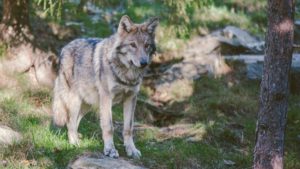
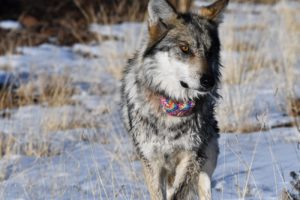
HAILEY, Ida. – Mollie’s Pack, one of Yellowstone National Park’s most well-known and fabled wolf packs, recently was recorded living outside the protective boundaries of the National Park. This development has triggered a fresh call for the states of Wyoming, Idaho, and Montana to establish a Sacred Resource Protection Zone to encompass non-park lands within 50 km (31 miles) of the boundaries of Yellowstone and Grand Teton National Parks. In 2017, Protect the Wolves, an Indigenous-led wolf advocacy group, officially petitioned the state governments of Montana, Wyoming, and Idaho to create this Sacred Resource Protection Zone to ban wolf hunting and trapping on lands surrounding the National Parks.
“We have waited patiently for the states of Wyoming, Montana, and Idaho to respond to our petition to create a Sacred Resource Protection Zone around these parks, but the state wildlife agencies have yet to even respond,]” said Roger Dobson, a Cowlitz Tribal Member and Director of Tribal Cultural Resources with Protect the Wolves. “[It’s long past time for the states to implement wolf protection for the lands surrounding Yellowstone and Grand Teton. Wolves are sacred to our culture and religions as Indigenous peoples, as are the lands of Yellowstone and Grand Teton National Parks, yet state governments have so far failed to grant park wolves the essential protections they need to fulfill their natural role in the Yellowstone ecosystem.”
A recent study shows that wolves living inside National Parks – protected from killing and harassment by humans – are suffering a high incidence of social disruption and pack disintegration due to human-caused wolf-killings outside park boundaries. Across five National Parks (Yellowstone, Grand Teton, Voyageurs, Yukon-Charley, and Denali), 82% of wolves that died of human causes over the previous 35 years died at the hands of trophy hunting and state and federal agencies’ officially-sanctioned killing outside park boundaries. In some cases, entire packs were wiped out, according to the research. Of the five National Parks, Yellowstone and Grand Teton had the highest proportion of their wolves killed by humans.
“The gray wolves of the northern Rocky Mountains represent one of North America’s most important wild wolf populations, both ecologically and genetically,” said Dr. Bridgett vonHoldt, wolf geneticist and lead author of the study. “Maintaining connected, socially intact packs is essential for preserving genetic diversity and the long-term resilience of the population. Establishing a buffer zone around Yellowstone and Grand Teton National Parks that limits hunting and trapping would significantly help reduce unnecessary mortality of Park-associated wolves and better protect the genetic and ecological processes that these iconic populations support.”
“The science is clear that state management of wolves outside these crown jewel National Parks has not shown sufficient restraint or responsibility to keep Park wolves alive,” said Erik Molvar, a wildlife biologist and Executive Director with Western Watersheds Project. “The dispersal of Mollie’s Pack – unusually large, beloved to the public, and also ecologically unique due to their penchant for specializing in bison as a primary prey – moving outside the Park boundaries into wolf habitats where trophy hunting is allowed, it puts a fine point on the need to establish the Indigenous-led Sacred Resource Protection Zone to give National Park wolves the protections they need to survive.”
Another recent study found that wolves in the broader Yellowstone population are beginning to lose their genetic diversity due to the overall population in the Parks and the surrounding region being too small to meet Minimum Viable Population thresholds.
Indigenous leaders have long called for wolf protections. Numerous tribal groups have signed an international Wolf Treaty, which recognizes a sacred relationship between wolves and Indigenous peoples, criticizes trophy hunting and lethal control in response to livestock losses, and calls for further expanded recovery of wolf populations with connectivity linkages in currently unoccupied parts of their historic range.
“The state governments should have listened to Indigenous voices and created this Sacred Resource Protection Zone around Yellowstone and Grand Teton National Parks, to prevent the killing of National Park wolves,]” said Dobson. “[In this new study, we now have definitive proof that the failure of state governments to protect wolves on the lands surrounding Yellowstone and Grand Teton are causing serious unnatural disruptions for wolf packs and preventing these wolves from living out their lives in a natural and undisturbed way.”
“State governments in Idaho, Montana, and Wyoming have had their chance to grant National Park wolves a zone of protection around these National Parks, but they were irresponsible, and ramped up wolf-killing instead,” said Molvar. “Now that the federal government has lost its court battle to keep wolves off the endangered species list, it’s time to end the killing by extending federal protections throughout the lower 48 states. In the meantime, the states surrounding Yellowstone and Grand Teton need to establish this Sacred Resource Protection Zone around the Parks to stop the loss of National Park wolf packs.”
“The killing of wolves and disruption of wolf packs living in in Yellowstone and Grand Teton National Parks is completely unnecessary and preventable, and with Mollie’s Pack now living outside Yellowstone, the federal government should step in to prevent it,” said Dobson. “It is imperative that government agencies including fish and game departments begin to recognize our sacred cultural beliefs, like the beliefs of all other religions, and our special relationship to the species that Native Americans hold as sacred.”
In recent decades, numerous famous wolves like “06,” the breeding female of the Lamar Canyon Pack, killed in 2012, and her daughter “Spitfire,” who succeeded her as the Lamar Canyon breeding female and was killed in 2018, were shot by trophy hunters outside Yellowstone. Scientific research shows that wolf-elk-bison interactions are complex, and the alteration of predator-prey dynamics from trophy hunting outside the Parks could interfere with the ecological recovery of Yellowstone that has been accomplished as a result of wolf reintroduction.
###